The complete guide to marketing workflow automation in 2026
Explore marketing workflow automation to streamline campaigns, measure ROI, and scale with AI-driven optimizations.
 Rebecca Pearson12 min read
On this page
- What is marketing workflow automation, really?
- How does marketing automation drive real ROI?
- Which marketing workflows should you automate first?
- How do you build a marketing automation strategy?
- How can you measure and optimize automation performance?
- What is the future of AI in marketing automation?
- Frequently asked questions
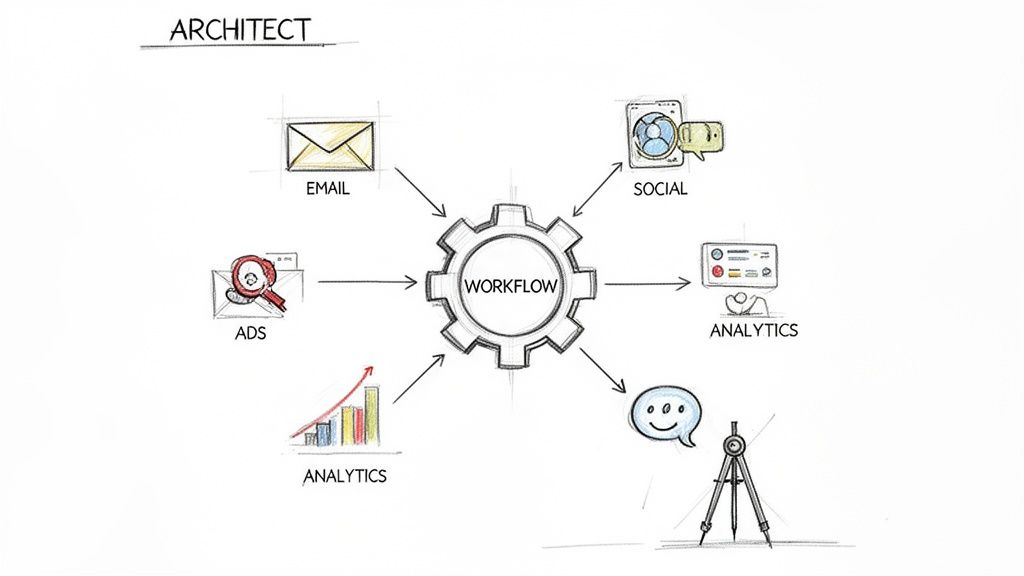
Marketing workflow automation is not about adding more tools to your stack. It is the architectural practice of designing intelligent systems that run marketing tasks autonomously. Imagine connecting your scattered tools — CRM, email platform, analytics — into a single, orchestrated engine that operates without constant human intervention.
Marketing workflow automation uses triggers, actions, and conditions to execute multi-step marketing processes automatically. It transforms manual, repetitive tasks into self-sufficient systems, enabling teams to scale campaigns and focus on strategic work. A recent report shows businesses that automate workflows are 69% more likely to outperform their revenue goals (Zapier, 2023).
Are you losing hours to repetitive tasks that pull you away from actual strategy? It’s a cycle that drains time and creates bottlenecks that stop growth.
With the right marketing workflow automation, you can slash manual data entry by up to 80%, according to Forrester. This frees your team to focus on the creative, big-picture work that actually moves the needle. You can build an intelligent engine that runs itself, connecting actions across platforms to nurture leads, analyze performance, and scale your campaigns.
The problem is, most automation tools force you into complex visual builders that are clunky and slow. A better way forward is a more fluid, conversational approach.
What is marketing workflow automation, really?
At its core, marketing workflow automation is the practice of designing a logical sequence of events. While a deep dive into marketing workflow management covers process structure, the fundamental building blocks remain constant regardless of the tool. You are the architect of a system that combines triggers, actions, and conditions to handle routine operations. This moves beyond simple no-code automation, which often handles single tasks, to orchestrate entire processes from start to finish.
- Triggers: The initial event that starts a workflow. This could be a form submission, an email link click, or a new brand mention on social media.
- Actions: The tasks the system executes automatically once triggered. Examples include sending a follow-up email, adding a lead to a CRM, or updating a spreadsheet row.
- Conditions: The rules that guide the workflow's path. For example, if a lead's company size is over 500, send them to the enterprise sales team; otherwise, add them to a nurture sequence.
How does marketing automation drive real ROI?
Understanding the components of a workflow is one thing; seeing it deliver tangible value is another. The true power of marketing workflow automation is not just about speed — it’s about fundamentally changing your team’s capacity. This transformation creates a clear return on investment across three interconnected areas.
Achieve radical efficiency gains
The most immediate benefit is time reclamation. Every manual task, from exporting a CSV to updating a CRM record, introduces friction that slows your entire operation. Automation acts as the lubricant for these rough spots, creating a system that flows.
Here's the deal:
Scheduling a month of social media content can consume a full day of planning and uploading. An automated workflow can pull approved content from a central database and schedule it for optimal engagement times. It reallocates your team's cognitive load from tedious tasks to high-impact strategic work.
Elevate lead quality and speed
Most teams focus on lead quantity. However, a smaller number of high-quality leads engaged instantly are far more valuable. Automation builds a system that identifies your best prospects and connects with them at speed. Instead of a person sifting through sign-ups, an intelligent workflow can score leads in real-time. A hot lead can be routed to a salesperson's calendar via Slack while a lower-scoring lead enters a nurture sequence.
The result? Your best prospects are contacted in minutes, not hours. According to recent marketing automation statistics, personalized campaigns can lift revenues by 5-15% (McKinsey, 2023).
Deliver a superior customer experience
Automation allows for personalized experiences at a scale impossible for human teams. Disconnected customer journeys create frustration and churn. Automated workflows bridge these gaps, creating a seamless experience. Imagine a new user starting a trial. A workflow can initiate a series of onboarding emails tailored to their goals, ping their account manager when they take key actions, and send a personalized offer before the trial ends. This turns the customer relationship into an ongoing, supportive conversation.
Which marketing workflows should you automate first?
You don't need to automate your entire department overnight. The real win comes from targeting high-impact, repetitive jobs that are dragging your team down. Think of them as operational anchors. By automating these core functions, you free your people for strategic work a machine could never do.
So, where should you begin?
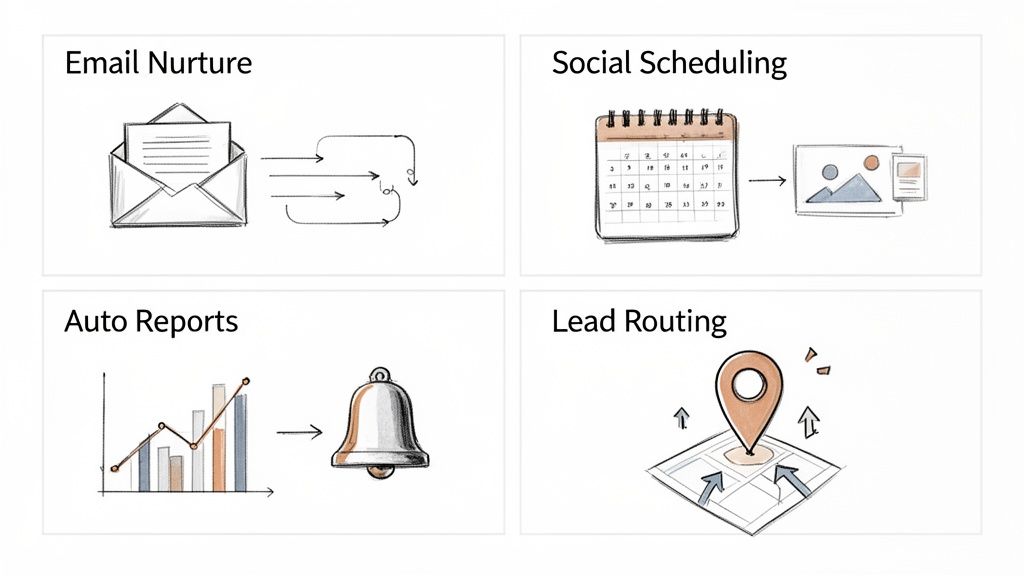
Look for tasks that are frequent, rules-based, and involve moving data between tools. Here are four foundational workflows that deliver measurable value immediately.
Automated email nurturing sequences
Manually following up with every new lead is a recipe for burnout. Automated nurturing solves this by delivering a timed sequence of messages based on user actions. The "why" is simple: no lead falls through the cracks. Exploring how to start automating lead generation is a practical first step. For example, when someone downloads an ebook, a workflow can instantly add them to a sequence that sends case studies and product tips over several weeks.
Social media content scheduling and monitoring
Maintaining a consistent social media presence is a grind. It requires constant planning, posting, and monitoring — precisely the work automation was built for. Looking into the best social media automation tools can help map out what's possible. You can batch-create content and let an automation schedule it for optimal engagement times. More advanced workflows can monitor for brand mentions, flagging important conversations in Slack for immediate response.
Automated analytics and performance reporting
How many hours does your team burn pulling numbers from Google Analytics, your CRM, and ad platforms for a weekly report? This is a classic automation candidate because it is 100% rules-based. An automated reporting workflow can connect to all your data sources, pull specific metrics, and compile them into a report that lands in Slack every Monday at 9 AM, like clockwork.
CodeWords Workflow: Weekly Performance Snapshot
Prompt: Every Monday at 9 AM, get the total users and sessions from Google Analytics 4 for the last 7 days, pull the number of new MQLs from HubSpot, and grab the total ad spend from Google Ads. Summarize these three metrics in a bulleted list and post it to the #marketing-updates Slack channel.
Output: A concise message delivered to Slack with the requested KPIs.
Impact: Saves approximately 1–2 hours of manual reporting work per week and ensures consistent data delivery.
Intelligent lead routing
When a hot lead submits a demo request, every second counts. Intelligent lead routing automatically assigns that lead to the right salesperson based on predefined rules. This slashes response time and connects the prospect with the person best equipped to solve their problem. For instance, a workflow can analyze a new lead's location and company size, routing a prospect from a manufacturing company in Germany to a European sales rep specializing in that vertical — all within seconds.
How do you build a marketing automation strategy?
Transitioning from one-off tasks to an interconnected strategy is how you build a marketing engine that scales. A good strategy is more than a time-saver; it creates a system where every automated component makes the whole team more effective. You just need a plan.
You might think you need engineering resources to pull this off. That’s no longer true. Modern AI assistants have leveled the playing field, letting operators build powerful systems without touching code.
Audit your existing manual processes
Before automating, you must understand your current processes. Identify the biggest bottlenecks. Where is your team burning the most time on tedious work? Map these tasks step-by-step. You will likely find data being copied across three different apps or hot leads going cold while awaiting follow-up. These are your primary targets for automation.
Define clear objectives and KPIs
Automation for its own sake is a waste. Your strategy must be tied to measurable business goals. Are you trying to increase your lead-to-opportunity conversion rate by 20%? Or cut weekly reporting time from three hours to ten minutes? Assign every automated workflow a Key Performance Indicator (KPI) to prove its value. Without a goal, you are just playing with new tools.
Select the right tools for integration
Your automation tool must integrate with your current tech stack. A platform that cannot connect to your CRM is a paperweight. Today, automation is non-negotiable — research from Ascend2 (2022) shows that 76% of all companies use marketing automation. Explore more data on marketing automation adoption. Look for platforms with extensive integrations to create a single source of truth.
Launch a pilot project to prove value
Do not try to automate everything at once. Pick one high-impact bottleneck from your audit and build a pilot project. This is your proof of concept. Starting small allows you to demonstrate value quickly, build momentum, and learn in a low-risk environment.
Establish governance for iteration
A marketing automation strategy is not a "set it and forget it" system. Assign clear owners for each workflow. Who is responsible for monitoring its performance and making adjustments? Schedule regular check-ins to review what works and what does not. This keeps your system sharp and evolving.
How can you measure and optimize automation performance?
Setting up an automated system is one thing; making it effective is another. Think of your marketing workflow automation not as a finished blueprint, but as a living engine. To get the most power out of it, you have to be willing to get under the hood and do some constant tuning. Without the right metrics, you’re flying blind. Measurement gives you the feedback you need to turn a good workflow into a great one.
Establishing your key performance indicators
First, you need to define what success looks like. Generic metrics are useless. You need KPIs tied directly to the job each workflow is designed to do. Vague goals produce vague results.
Consider these sharp KPIs:
- Lead-to-Opportunity Velocity: How quickly does a new lead become a qualified sales opportunity?
- Workflow Conversion Rate: What percentage of people in a nurture sequence take the desired action, like booking a demo?
- Automated Sourcing Cost-per-Lead: Calculate the total cost of tools and time, then divide by the number of leads generated for a hard ROI.
- Customer Lifetime Value (CLV) by Nurture Path: Are leads from Workflow A more valuable over their lifecycle than those from Workflow B?
With 68% of companies planning to increase their automation spend, they’re expecting an average revenue bump of 34%. To dive deeper, you can explore more marketing automation statistics on EmailVendorSelection.com to see just how critical performance tracking is.
A framework for continuous optimization
Once your KPIs are set, optimization begins. This is a constant cycle of testing, learning, and tweaking. This five-step roadmap provides a solid structure for building and refining your strategy.
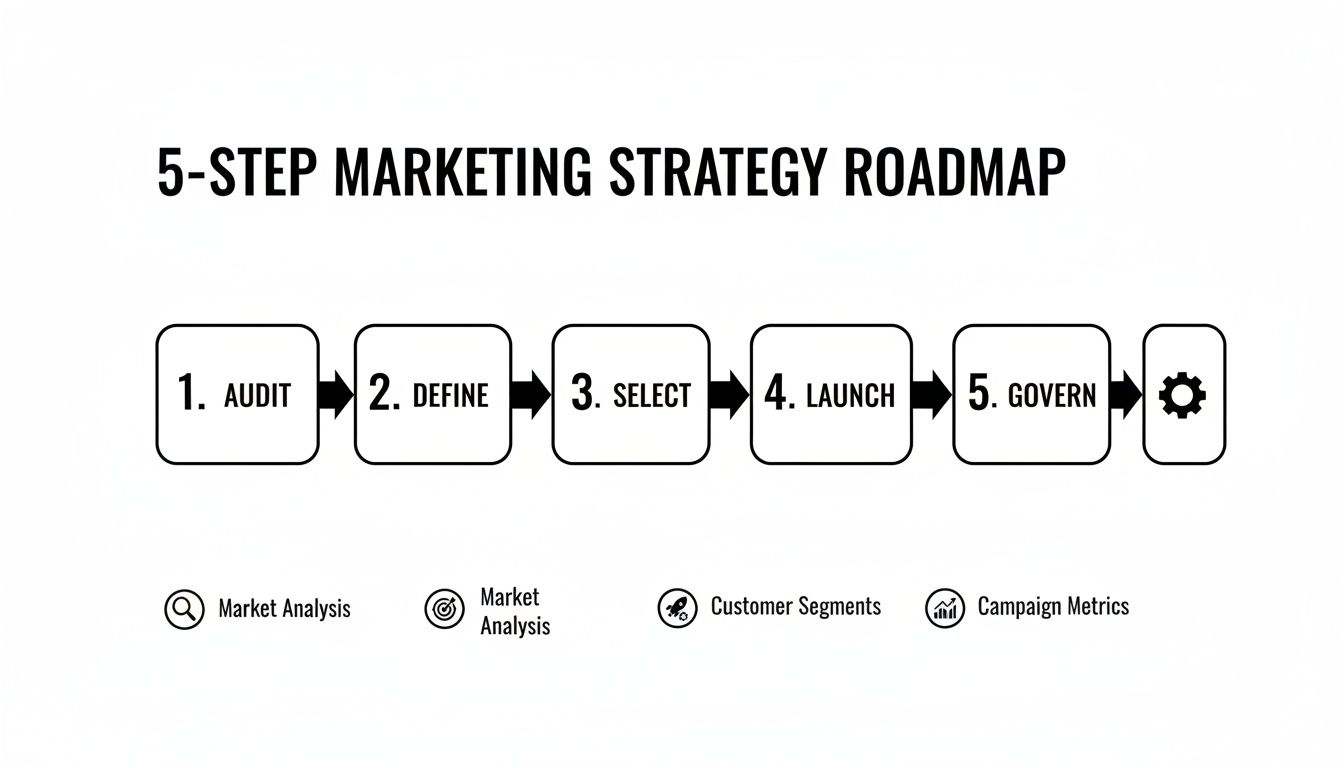
Governance is a core part of the lifecycle, and a huge piece of that is A/B testing. You should systematically test variables within your workflows. Try different email subject lines, experiment with send times, or change the number of touchpoints. Document what works, then scale the winners. This methodical approach ensures your automations become smarter over time.
What is the future of AI in marketing automation?
The systems we build today are just the ground floor. The future of marketing automation is not about executing commands; it is about anticipating needs and creating novel solutions. We are moving past the simple "if-this-then-that" logic into an era where AI becomes a strategic partner. This shift puts you in the driver's seat as the architect of intelligent, self-optimizing marketing engines.
Soon, your automation will not just personalize an email. It will predict a customer's journey and build the ideal path for them in real-time. You can get a sense of what's already possible by exploring modern AI workflow automation tools.
From executor to autonomous agent
The next frontier is autonomous agents. Imagine giving an AI a high-level goal, like "increase qualified leads from North America by 15% this quarter," and letting it design, run, and optimize the campaigns to achieve it. The agent could conduct its own research, draft ad copy, allocate budget, and tweak its strategy based on live performance data without human intervention.
This is where the architect metaphor comes to life.
Your job becomes designing high-level objectives and setting the guardrails for these intelligent systems.
The implication is massive. Marketing teams will shift from operators managing dozens of workflows into strategists overseeing a portfolio of autonomous agents. Your focus moves from the ‘how’ to the ‘why’ — defining the direction and letting AI handle the complex execution. This is not about replacing marketers; it is about elevating their role to that of true system designers.
Frequently asked questions
Is marketing automation just for B2B?
No, it's for B2B and B2C, but the strategies differ. B2B automation focuses on long sales cycles with lead scoring and drip campaigns. B2C automation is about creating personal experiences at scale, like abandoned cart reminders and targeted loyalty rewards. The tools are similar, but the application is tailored.
What is a realistic cost to start with marketing automation?
It depends on the pricing model. Legacy platforms often charge by contact count, which can get expensive quickly. Modern, AI-native platforms like CodeWords often use a usage-based model. This allows small teams to access powerful marketing workflow automation without a large upfront investment, paying only for the tasks they run.
What’s the biggest mistake people make when first automating?
Most people believe they should automate everything at once. The opposite is true. The most common pitfall is trying to automate every task on day one without a clear plan, resulting in a tangled mess. Start small. Find one manual task everyone on your team dislikes, automate a simple fix, and measure the result. Build from that success.