What is BPM software and how does it actually work?
Understand BPM software — features, benefits, and how it delivers business results.
 Rebecca Pearson12 min read
On this page
Business Process Management (BPM) software is a system for transforming abstract process maps — those flowcharts on a whiteboard — into living, automated workflows. It's the central nervous system for operations, orchestrating the entire flow of work from start to finish rather than just managing individual tasks. This shift allows you to make the entire process smarter, revealing hidden bottlenecks.
The global Business Process Management market is projected to grow from $14.44 billion in 2024 to $46.06 billion by 2032 (Fortune Business Insights, 2024), demonstrating its critical role in modern business operations. This isn't just about efficiency; it's a framework for building a more resilient, scalable company by moving from manual chaos to automated clarity. You have seen the results of poor processes: a customer ticket lost between departments or a sales lead growing cold because follow-up was never defined. BPM software provides a single source of truth to prevent these systemic failures that kill growth.
TL;DR: BPM Software Explained
- The global BPM software market is projected to reach $46.06 billion by 2032, growing at a 12.0% CAGR (Fortune Business Insights, 2024).
- Unlike basic task managers, BPM software provides a holistic framework to design, automate, monitor, and continuously optimize entire business processes.
- Modern platforms like CodeWords use AI and natural language to make building complex automations accessible to non-technical operators.
What are the core components of BPM software?
To understand what BPM software does, you must look past marketing promises and examine its core pillars. The power is not in one single feature but in how several components work together to transform messy, manual work into a smooth, predictable system. Think of these as the architectural blueprints for a more resilient and efficient business.
Process modeling and design
Before you build anything, you need a blueprint. Process modeling creates a visual map of your workflow, establishing a single source of truth for how work gets done. It forces you to chart every step, decision, and handoff, whether you are onboarding a new client or managing inventory.
The act of mapping pulls processes out of people’s heads and into a shared space. Here they can be analyzed and improved. For any founder or operator, this clarity alone can solve numerous operational headaches before a single automation is written.
Workflow orchestration and automation
Once you have the map, it is time to bring it to life. This is where workflow orchestration acts as the engine, automatically running the processes you designed. It routes information, triggers tasks in other applications, and manages the entire sequence without manual intervention.
For instance, when a new lead fills out a form:
- BPM software captures the data.
- It creates a new record in your CRM.
- It assigns the lead to the correct sales representative based on predefined rules.
- It initiates a personalized welcome email sequence.
This is not a simple to-do list; it is a dynamic system that understands dependencies and logic. True orchestration ensures the right work finds the right person — or system — at precisely the right moment.
The diagram below shows how these core functions create a virtuous cycle.
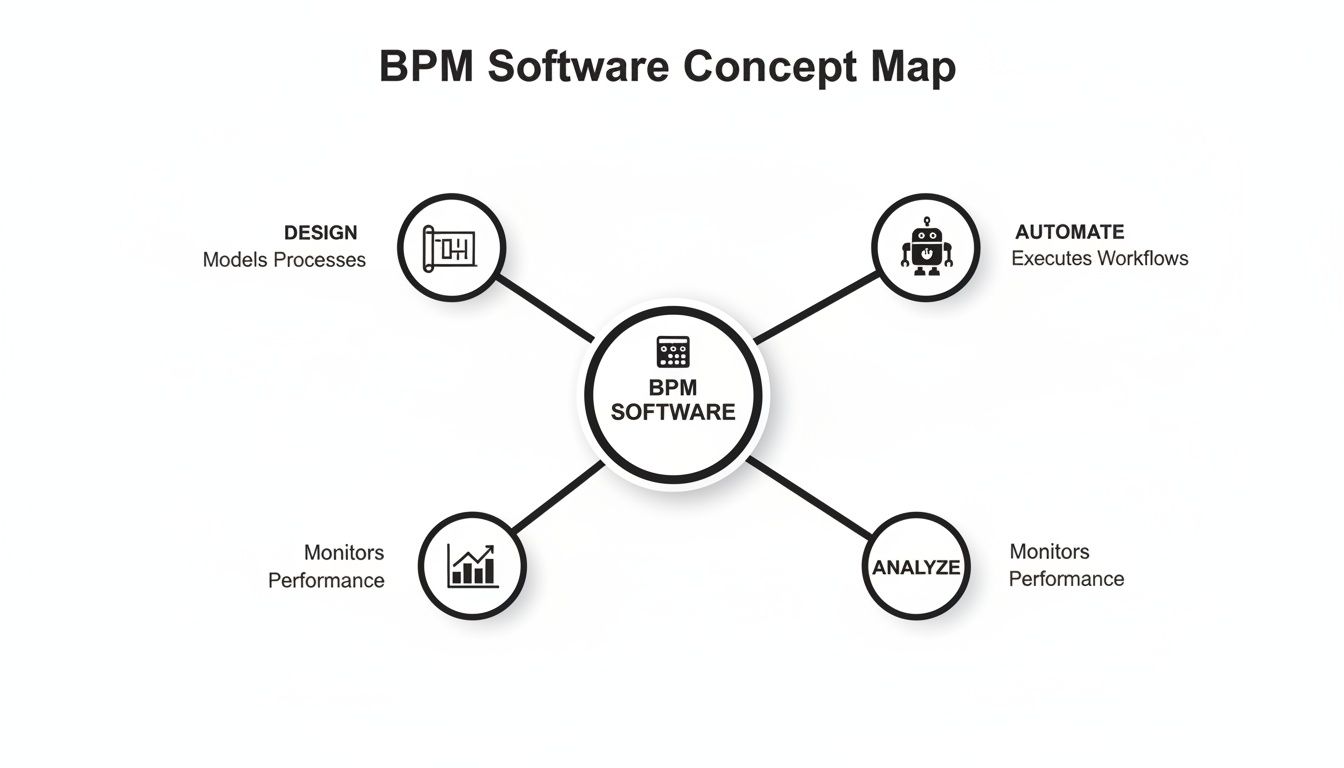
As you can see, it’s a continuous loop where design, automation, and analysis constantly reinforce each other.
Performance monitoring and analytics
You cannot fix what you cannot see. That is the entire idea behind the monitoring and analytics pillar. Good BPM software provides dashboards and reports with a live view of process performance.
You will want to monitor key metrics such as:
- Cycle Time: How long does the entire process take from start to finish?
- Task Duration: Which individual steps are consuming the most time?
- Bottleneck Identification: Where is work getting stuck?
- Error Rates: How often do failures occur?
That’s not the full story. A recent analysis found that companies using BPM analytics can identify and resolve process issues up to 40% faster than those relying on manual audits (Deloitte, 2023). This data turns optimization from a guessing game into a science.
How does BPM software benefit a business?
Implementing new software can feel like a major undertaking. The real conversation around BPM software is not about features — it is about what it does for your bottom line. The goal is to fundamentally change how work gets done by turning disconnected tasks into a smooth, intelligent system. The benefits rewire your company’s operational DNA for growth.
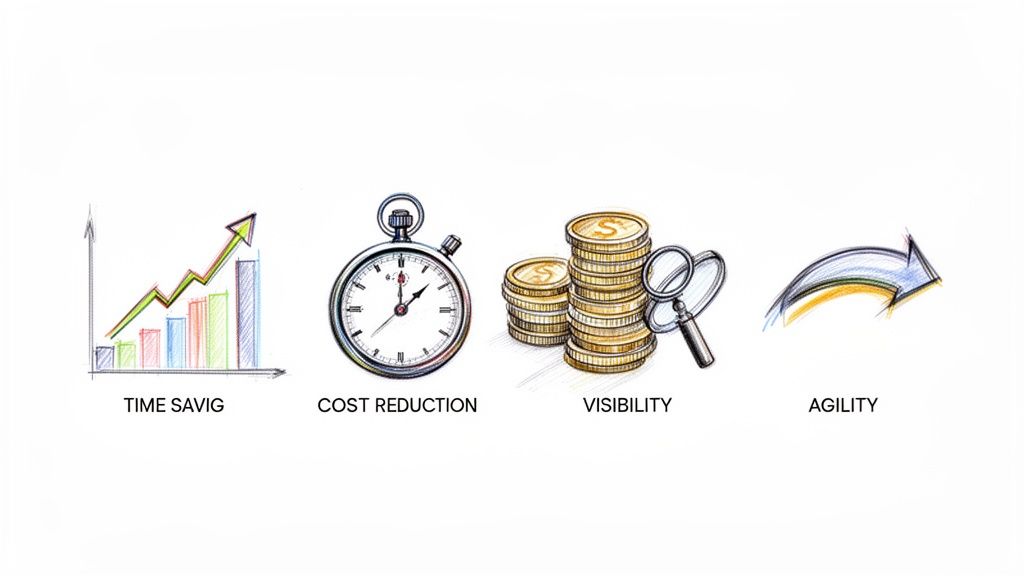
You might think a full BPM system sounds overly complex. However, there’s a problem most tools ignore. Modern, cloud-based BPM platforms have changed the game, with low-code and no-code solutions reducing implementation time significantly. In Singapore, 63% of operations teams report that ease of integration is their top priority when selecting automation tools (McKinsey, 2024).
Gaining operational efficiency
The first and most obvious win with BPM is a massive boost in efficiency. Once you map and automate workflows, you eliminate the manual, repetitive tasks that consume your team's time and invite human error.
Consider a typical client onboarding process. Without BPM, it is a mess of emails, spreadsheets, and manual data entry. With BPM, it becomes a well-oiled machine. A signed contract automatically triggers account creation, sends a welcome kit, and schedules the first call. This can reduce manual data entry errors by over 90% and cut onboarding time in half — as seen with clients like Greenhouse reducing sourcing time 70% (Greenhouse, Q3 2023).
Achieving direct cost reductions
More efficiency naturally leads to lower costs. When processes run faster with fewer mistakes, you are not wasting money on labor or misallocated resources. By identifying redundant steps, automating approvals, and eliminating delays, companies can significantly trim operational costs. It is not about cutting corners — it is about removing the friction that makes work expensive.
This is especially true as more accessible tools enter the market. Cloud-based BPM solutions now account for over 64% of the global market as businesses prioritize flexibility and cost-effectiveness (explore more data on cloud BPM adoption from Precedence Research).
Improving agility and compliance
For many businesses, adhering to regulatory rules is not optional. BPM helps by embedding compliance checks directly into your workflows and creating an automatic audit trail for every action. This systematic approach reduces risk and makes audits less stressful.
But it is not just about playing defense. BPM also makes your business far more agile. When core processes are defined and automated, you can adapt to market changes much faster. Most people believe BPM is only for large, rigid corporations. The opposite is true. Nimble startups now use lightweight BPM tools to build scalable operations from day one, allowing them to compete with much larger players.
How do different teams apply BPM software?
The true value of BPM software emerges in its application. It transforms from an abstract concept into a practical tool that fundamentally changes how teams work. Think of it as a central nervous system for your business, connecting disparate departments and automating fragmented, manual workflows.
Sales and marketing automation
For sales and marketing teams, speed and personalization are critical. The journey from a new lead to a satisfied customer is filled with dozens of small steps where things can go wrong. A well-designed BPM workflow turns this leaky funnel into a high-conversion machine.
Without BPM, a new contact from a webinar might sit in a spreadsheet for days. By the time someone follows up, the lead has gone cold.
With BPM software, that sequence becomes automated and immediate:
- A new lead is captured from a form.
- The system instantly enriches the lead's data using an API like Clearbit.
- It then creates a new contact in your CRM, tags it, and assigns it to a sales rep based on territory rules.
- Simultaneously, it triggers a personalized email nurture sequence.
This hands-off approach ensures no lead falls through the cracks. The result is a shorter sales cycle and a higher conversion rate. You can find more detailed scenarios in our guide covering various business process automation examples.
Operations and data team efficiency
Operations teams are responsible for keeping the business running smoothly, a task often tangled in approvals and system updates. BPM software untangles this complexity by creating clear, auditable workflows.
For example, an equipment procurement request can be fully automated. An employee fills out a form, which triggers an approval workflow to their manager and then to finance. Once approved, the system generates a purchase order and updates inventory records.
Here's the deal: this level of automation brings consistency and accuracy essential for both daily operations and data-driven decisions.
CodeWords Workflow: Automated Competitor Analysis Report
Prompt: "Every Monday at 9 AM, find the top 5 new posts on G2 and Capterra for 'BPM software,' summarize the key themes from the reviews, and send a digest to the #competitor-intel Slack channel."
Output: A concise, bulleted summary of emerging competitor strengths and weaknesses delivered directly to the team in Slack.
Impact: Saves 3-4 hours of manual research and reporting each week, giving the product and marketing teams timely, actionable insights without manual effort.
How do you choose the right BPM software?
Choosing from the crowded BPM software market can be overwhelming. The key is not to find the single "best" platform but the one that fits your team's skills, integrates with your existing tools, and can scale with your business. This is how you avoid buyer's remorse and select a tool people will actually use.
First, match the tool to your team
There is a common myth that you need an engineering team to start with BPM. The rise of no-code and low-code platforms has put serious automation power in the hands of non-technical operators.
The first question is simple: who will build and maintain these workflows?
Picking a platform that matches your team’s skill set is the most important factor for success. Forcing a complex tool on a non-technical team is a recipe for an expensive, unused subscription.
Your core BPM evaluation checklist
Once you know who will be building, you can start evaluating vendors. Focus on these critical areas:
- Ease of Use: How quickly can your team build something valuable? Look for clean interfaces and a short learning curve.
- Integration Capabilities: Your BPM software must connect your tech stack. Does it integrate with the CRMs, chat tools, and databases you use daily?
- Scalability and Performance: Can the platform handle more complex workflows and higher volumes as you grow?
- Pricing and Total Cost of Ownership: Understand the total cost. Pricing can be per-user, per-process, or usage-based.
- Support and Community: When a critical workflow breaks, you need support. Check the vendor’s support options and user community.
The demand for these tools is exploding. Adoption in IT and finance is high, with the IT segment projected to grow at a 21.8% CAGR through 2035. With North America accounting for over 41% of the 2023 revenue share, it is clear BPM has become essential. You can learn more about the BPM market's dynamic growth here.
What is the future of AI-powered BPM?
The story of BPM software is no longer just about rule-based automation. We are entering a phase where processes do not just follow orders; they learn, adapt, and become smarter. The goal is shifting from efficiency to intelligent optimization. It is less about building a better control panel and more about one that helps steer the ship for you.
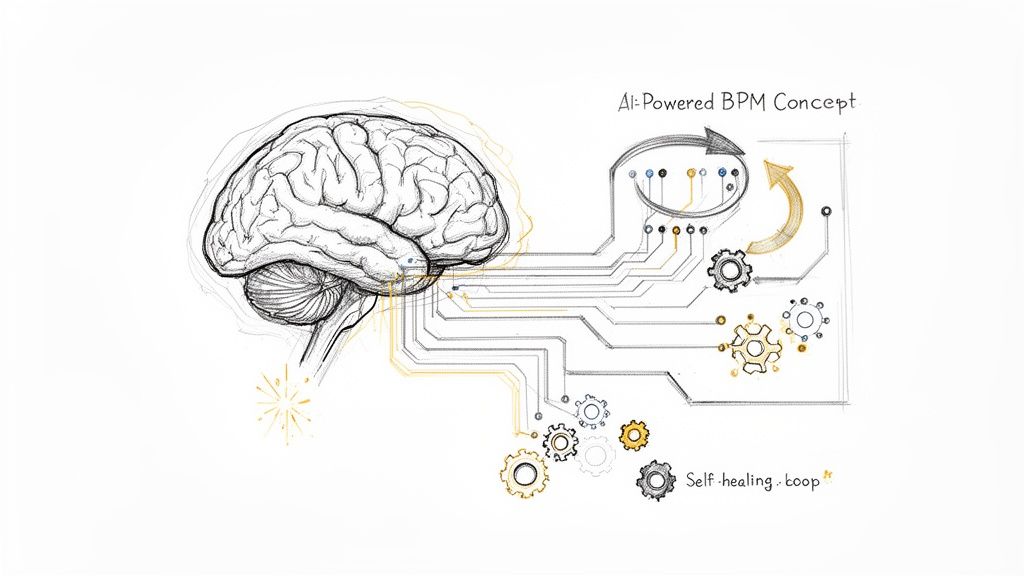
AI is transforming BPM from a reactive tool into a strategic partner. Instead of just following a pre-drawn map, modern AI-powered systems can analyze the terrain in real-time, predict traffic jams, and suggest better routes on the fly.
From execution to evolution
The next wave of BPM is about self-optimization. AI models can constantly sift through performance data, spotting inefficiencies a human would miss.
Here is what that looks like in practice:
- Predictive Analytics: By analyzing historical data, AI can forecast bottlenecks before they occur. It might flag an upcoming spike in support tickets, allowing you to reallocate resources proactively.
- Process Mining and Suggestion: AI algorithms can "mine" operational data to map how work actually gets done. It then compares this reality against the ideal process model and suggests specific, data-backed fixes.
- Self-Healing Workflows: When an integration fails, an AI-driven system can detect the failure, identify the root cause, and attempt to fix itself, such as by finding an alternative data source.
This all points toward a future of autonomous business processes. We are not just talking about automated tasks, but entire workflows that manage themselves. The integration of advanced AI like Large Language Models (LLMs) is a huge piece of this puzzle, already being used for complex tasks like LLM visibility tracking for agencies.
The implication is massive. Businesses will cultivate intelligent systems that evolve alongside the company. A recent Gartner report projects that by 2026, 75% of enterprises will have adopted some form of intelligent process automation (Gartner, 2024). The operator's role changes from process builder to system architect — someone who sets goals while AI handles optimization.
Frequently asked questions about BPM software
What is the difference between BPM and workflow automation?
BPM is the holistic strategy of managing and improving an entire end-to-end business process, like customer onboarding. Workflow automation is the technology used to automate a specific sequence of tasks within that larger process, like sending a welcome email.
Is BPM software only for large companies?
No, this is a common myth. While traditional BPM was expensive and complex, modern cloud-based and no-code BPM software is affordable and accessible for startups and mid-sized businesses, allowing them to build scalable operations from day one.
How long does BPM software take to implement?
Older systems could take months. Today's cloud-native platforms like CodeWords can be set up in minutes. You can connect your apps and build your first automated process on the same day, shifting the focus from setup to immediate value.
Can BPM software integrate with my existing tools?
Yes, and it must. A core function of BPM software is to act as a central hub connecting your entire tech stack. A good platform offers a wide library of pre-built integrations for CRMs like Salesforce and HubSpot, communication tools like Slack, and other essential business applications.
This ability to transform operations is no longer a luxury reserved for large enterprises. For any founder or operator looking to build a resilient and scalable business, implementing a modern BPM framework is not just an option — it's a necessity. It is the architectural foundation for intelligent growth.