Your complete guide to business process management software
Discover how business process management software streamlines operations. Learn core capabilities, implementation strategies, and how AI automation drives ROI.
 Rebecca Pearson9 min read
On this page
Operational drag is the silent tax on your team's time — the manual data entry, messy handoffs, and communication gaps that quietly kill productivity. You know the feeling. It’s when customer onboarding takes days instead of hours, or when sales and marketing operate from different playbooks.
Business process management software is a framework for architecting how work gets done. By 2034, the BPM market is projected to hit $91.87 billion, driven almost entirely by AI's ability to transform static workflows into dynamic, intelligent systems (Visiongain, 2024). This is about building a digital nervous system for your company, connecting disparate tools into a single, responsive whole.
What is business process management software?
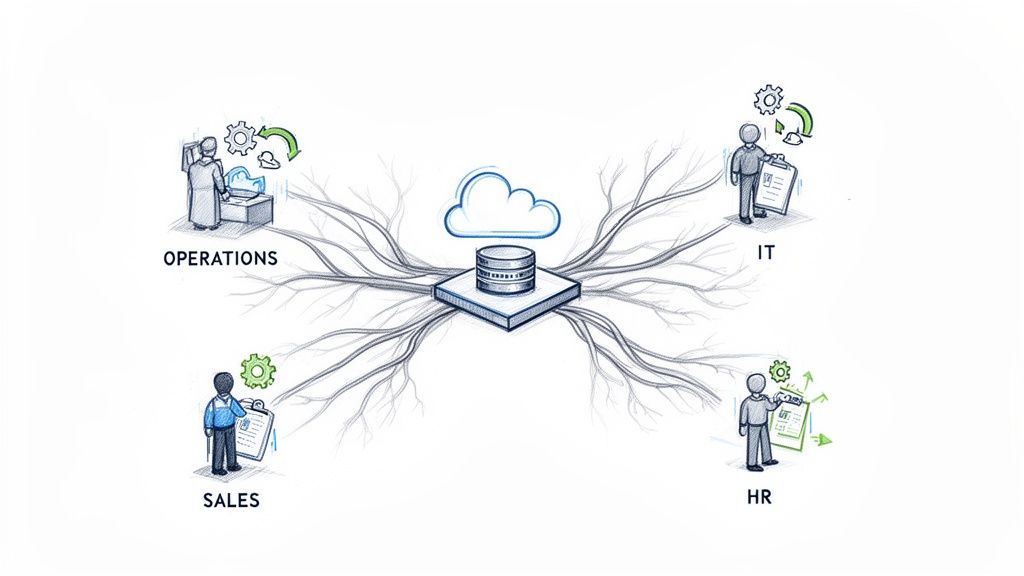
Business process management software eliminates invisible friction. Instead of juggling spreadsheets, email chains, and disconnected apps, it provides a single source of truth that connects everything. The goal is to move from operational chaos to control and predictability, turning processes from liabilities into reliable, scalable assets.
Here’s the deal: modern BPM is not about enforcing a static set of rules. It is about building an adaptive organization where anyone can transform a good idea into an automated reality. The best way to think about it is as a digital nervous system for your company. It connects your CRM, ERP, and communication platforms into one cohesive system. Your processes become living assets that you can design, automate, and optimize using real data.
This is a significant shift from the rigid, complex platforms of the past. The most effective solutions today are flexible, AI-native systems that empower the operators who actually do the work. This shift explains why the global BPM market is projected to hit $91.87 billion by 2034, growing at a 17.2% CAGR, primarily due to AI integration. You can read more about the BPM market forecast and its drivers. This evolution moves BPM from a system that follows instructions to one that actively learns and suggests improvements.
How does modern BPM software actually work?
To understand modern business process management, you must look past a checklist of features. The real value is not in disparate functions; it is in a few core capabilities that architect a predictable, scalable system from operational chaos. Think of these as the components that construct your company's digital nervous system, ensuring every part works together smoothly.
Process modeling and design
This is the blueprinting stage. Before automating anything, you need a clear, visual map of how work gets done. Process modeling allows you to lay out every task, decision point, and handoff. This is not about creating static diagrams for a dusty binder. It is about building a living model the team can understand and challenge, exposing hidden redundancies before automation even begins.
Workflow automation engine
If process modeling is the blueprint, the automation engine is the construction crew. This is the heart of any business process management software. It executes the workflows you design, routing tasks, triggering actions in other apps, and ensuring the process runs identically every time. A capable engine handles complex conditional logic, allowing automated processes to adapt without human intervention. This is how you reclaim hours lost to manual coordination.
System and application integrations
Processes do not live in isolation. They span multiple applications — your CRM, project management tool, and internal chat. A modern BPM platform’s power lies in its ability to act as the connective tissue between these systems. Using pre-built connectors and flexible APIs, it ensures data flows seamlessly, killing the soul-crushing work of copying information from one screen to another. This creates a unified operational layer across your entire tech stack.
Performance monitoring and analytics
You cannot fix what you cannot see. Modern BPM tools include real-time dashboards and analytics that offer an unprecedented view of your operational health. They track metrics like process cycle time, error rates, and overall throughput. Your abstract workflows become quantifiable assets. This moves you from guesswork to data-driven decisions. To build more efficient systems, explore our guide on choosing the right workflow automation software.
How can you implement BPM software effectively?
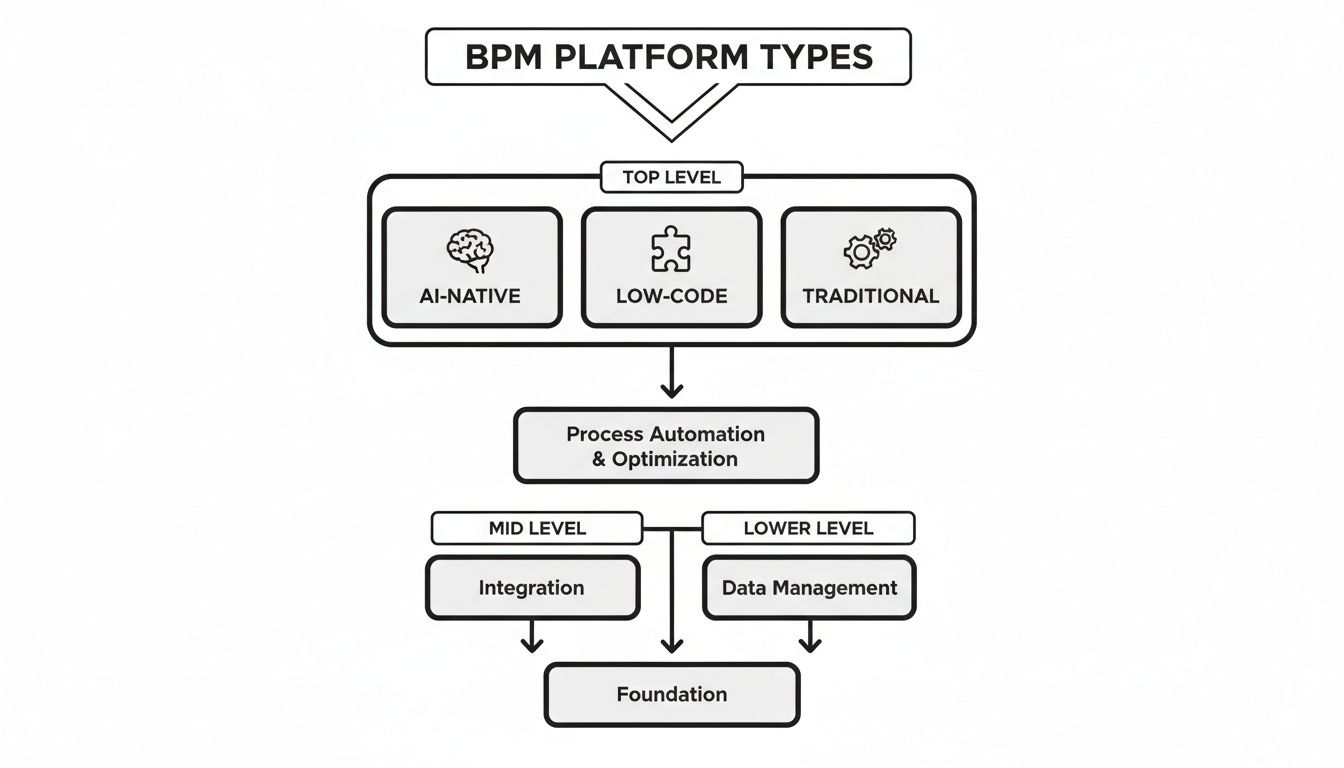
Implementing business process management software is not about a massive, disruptive overhaul. It is a strategic transformation where you build momentum one win at a time. The goal is a repeatable playbook that turns small victories into a company-wide habit of continuous improvement.
This approach avoids the classic trap of chasing a perfect, all-in-one system. Instead, you conduct a series of controlled experiments.
Start with a high-impact pilot project
Resist the urge to fix everything at once. Pick a single, visible process that is straightforward to improve. The best candidates often touch customers or revenue and suffer from well-known pain points. Customer onboarding is a perfect example. It is a critical process for retention but is often a mess of manual handoffs. Automating it creates a strong first impression and a clear ROI. Automating customer support can reduce response times by up to 90% (Zendesk, 2023).
Map the "as-is" and design the "to-be"
Once you have chosen a pilot, you must understand it completely. Map the "as-is" workflow — every step, decision, and system interaction as it exists today. Talk to the people who do the work. These conversations uncover hidden steps and workarounds that official documents miss. With a clear picture of the current state, you can design the "to-be" workflow. The goal is not just to automate old steps but to rethink the entire flow, eliminating redundant tasks for good. For a deeper look, see our guide on how to streamline business processes.
Bust the specialist myth
You might think you need a team of expensive consultants to implement BPM. That may have been true for rigid platforms of the past, but modern systems are different. Most believe process automation requires deep technical skill. The opposite is true for AI-native tools. They are architected to empower the actual process owners — the operators on the front lines — to build and deploy their own workflows. AI-native systems dramatically lower the barrier to entry, enabling faster implementation cycles led by business users. Practical, team-level automation like learning how to go about automating social media posts creates crucial early wins.
Where is BPM software most valuable?
The value of business process management software is not in a single, company-wide system. It is in a collection of targeted solutions that fix specific pains within each department. It becomes a universal translator, letting teams build the exact workflows they need to eliminate friction.
Sales lead-to-close automation
For sales teams, speed and consistency are critical. A common problem is a leaky pipeline where leads fall through the cracks due to slow follow-ups. A BPM workflow plugs these leaks. When a new lead enters your CRM, a workflow can instantly enrich their data, score them, and assign them to the right representative. As Gartner found, 74% of B2B buyers choose the vendor who was first to add value (2022). Automating lead assignment reduces response time from hours to minutes, directly impacting conversions.
Marketing content operations
Marketing teams often face chaos in content creation. The lack of a central hub leads to missed deadlines and off-brand messaging. A content operations workflow acts as a single source of truth. It can route an idea through approvals, create tasks for writers and designers, and schedule the finished piece across social channels. This turns a frantic process into a predictable content engine. You can find more applications in these business process automation examples.
Operations and customer onboarding
For operations teams, a poor customer onboarding experience is a direct path to churn. The typical bottleneck is the manual handoff from sales. BPM software smooths this sequence. When a deal is marked "closed-won" in the CRM, a workflow can automatically send a welcome email, create the customer account, and assign an onboarding specialist. This creates a polished experience and helps customers see value faster, a key principle that also applies when automating customer service workflows.
CodeWords Workflow: New lead enrichment and assignment
Prompt: When a new lead is created in HubSpot, enrich the contact's company data using Clearbit, then check if the company size is over 50 employees. If it is, create a deal, assign it to Jane Doe, and send a Slack message to the #sales-leads channel.
Output: A multi-step workflow connects HubSpot, Clearbit, and Slack.
Impact: Reduces manual lead processing time by 95%, from 10 minutes per lead to under 30 seconds, ensuring high-value leads are actioned immediately.
What is the future of BPM?
Business process management is shifting from rigid, static rules to dynamic, adaptive systems, a transformation driven almost entirely by AI. BPM is no longer a digital rulebook; it is becoming a partner in determining how work gets done and how to do it better. This evolution is architecting a self-healing digital nervous system for the entire organization.
That’s not the full story. The rise of process intelligence is central to this shift. Modern AI can connect to a company’s operational ecosystem — from its CRM to internal chat logs — and analyze it in real time. These algorithms spot subtle bottlenecks and inefficiencies a human would miss, flagging them for optimization before they become significant problems. This leads directly to hyperautomation, where organizations rapidly find, vet, and automate as many processes as possible.
The implication is clear. Mastering modern business process management software is no longer just an operational task. It is about building an organization designed for constant change. In a market where stability is rare, the ability to quickly redesign and deploy core processes is the only sustainable competitive advantage. The new frontier is building systems that do not just follow instructions but actively learn, adapt, and help you decide what to do next.
Frequently asked questions
What's the real difference between BPM and workflow automation?
Workflow automation handles a single, linear task, like approving an invoice. Business process management software is the strategic playbook for orchestrating multiple workflows, human decisions, and systems to achieve a major business goal.
Is BPM software only for giant corporations?
That is an old myth from the era of clunky, on-premise systems. The new wave of AI-native and no-code platforms is built for everyone, allowing startups and small businesses to automate core processes without a dedicated IT department.
How quickly will I actually see results from BPM software?
With a modern, AI-native platform like CodeWords, you can deploy a simple, high-impact workflow in minutes and see immediate benefits. For a larger process like customer onboarding, expect to see a clear return within the first few weeks.
Is it difficult to integrate BPM software with existing tools like Salesforce or Slack?
No. Modern BPM platforms are built for integration. Most offer pre-built connectors for popular apps, and flexible APIs allow for custom connections, creating a unified system without needing to replace the tools your team already uses and likes.