The complete guide to modern lead generation platforms
Learn how lead generation platforms build predictable revenue — design, integrate, and automate your funnel.
 Rebecca Pearson18 min read
On this page
- What is a lead generation platform?
- How do you architect a modern lead generation system?
- Which channels drive the highest quality leads?
- How does AI automation connect disparate platforms?
- What are the most essential platform features?
- What are the implications for your growth strategy?
- Frequently asked questions
Most companies treat lead generation like a frantic hunt — chasing individual prospects with a patchwork of disconnected tools. This manual scramble consumes resources, creates data chaos, and fundamentally cannot scale. The process feels less like building a skyscraper and more like stacking loose bricks.
Lead generation platforms are software systems that automate attracting, capturing, and qualifying potential customers. They create a unified architecture for predictable growth, moving beyond simple contact collection. A recent report highlights that marketers using automation generate twice the number of leads as those using blast email software (Autopilot, 2023). This is about designing an engine, not just buying parts.
At their core, these platforms validate the pain of disjointed marketing efforts. They promise to transform chaotic lead flow into a streamlined, automated system, often reducing lead processing times by over 70%. The solution, however, isn't found in a single, all-in-one tool, but in a central AI layer that unifies your specialized apps.
TL;DR
- Marketers using automation generate 2x the number of leads as those using only blast email software (Autopilot, 2023).
- Modern lead generation platforms are not single tools but unified systems, often connected by an AI automation layer that acts as a central nervous system.
- The goal is to build a predictable growth engine, not just a contact collection tool, by architecting a seamless flow from attraction to qualification.
What is a lead generation platform?
A lead generation platform is an integrated system designed to construct a predictable pipeline of potential customers. Think of it as the architectural blueprint for your revenue engine. Its purpose is to stop the endless chase for individual leads and instead build a system that consistently brings qualified prospects to you.
This is not about finding one "magic" tool. The power of a modern platform comes from creating an interconnected engine where every component performs a specific job in concert. To grasp how these systems function, it helps to first understand the core concept of lead generation. A platform approach transforms this concept from a series of manual tasks into a cohesive, automated process.
What are the core components of a platform?
A true platform unites several functions that typically exist in separate, siloed tools. The integration is what separates a platform from a mere collection of software. It creates a seamless journey from a prospect's initial awareness to a sales-ready lead without requiring manual handoffs.
These systems are constructed upon four pillars:
- Attraction: This is about bringing the right people to your digital properties. It includes channels like content marketing, SEO, and paid ads — all designed to capture the attention of your ideal customer.
- Capture: Once you have their attention, you must obtain their contact information. This usually occurs on landing pages with web forms or through interactive content like webinars and quizzes.
- Qualification: Not all leads are ready to buy. Here, the system automatically determines who is a high-intent prospect and who requires more nurturing. It uses processes like lead scoring and data enrichment to separate sales-ready leads from the rest.
- Routing: Finally, the system directs qualified leads to the correct destination. This could mean automatically creating a new contact in your CRM, alerting a sales representative in Slack, or initiating a personalized email sequence.
Why does a platform approach matter?
When your tools do not communicate, you get data silos and messy manual transfers. This is where leads get lost and processes break. A platform-centric approach solves this by creating a single source of truth for your entire lead lifecycle.
By connecting these functions, you build a system that is not just more efficient but also more intelligent. It allows you to see a lead's entire journey, determine which marketing efforts are actually driving revenue, and ensure no opportunity falls through the cracks. This systematic approach is the foundation of scalable growth.
How do you architect a modern lead generation system?
To build a lead generation system that works, you must think like an architect, not a tool collector. It is about designing a cohesive structure where every piece supports the others. This is not simply about combining a few applications; it is a deliberate blueprint designed to guide a prospect from their first flicker of interest to a qualified lead, ideally without human intervention.
The entire structure stands on four foundational pillars. Each pillar has a specific job, much like the foundation, framing, and electrical systems in a building. If one part is flawed, the entire structure becomes unstable. For example, obsessing over lead capture forms before you have a solid plan to attract visitors is like installing windows on a house that has no walls.
What is the attraction layer?
This is the bedrock of your entire system. The sole objective here is to draw your ideal customer profile (ICP) to your website, blog, or social channels. Without a steady stream of the right traffic, the rest of your elegant architecture is useless.
Attraction is about creating assets that pull prospects in by offering genuine value, not by pushing a sales pitch. The core components are straightforward:
- Content Marketing: Writing articles, guides, and producing videos that answer your audience’s most pressing questions.
- Search Engine Optimization (SEO): Ensuring that when people actively search for solutions, your content is what they find.
- Paid Advertising: Using targeted ads on platforms like LinkedIn or Google to reach precise market segments.
This layer is fundamentally about earning attention.
What is the capture layer?
You have attracted the right audience. Now what? The next step is providing them a way to identify themselves. The capture layer is the framework of your system, creating obvious pathways for interested people to raise their hand and enter your ecosystem.
Here’s the deal: this is where you turn anonymous website visitors into known contacts. You will rely on elements like high-converting landing pages, clear calls-to-action (CTAs), and web forms that are simple to complete. The mission is to make the exchange of information feel effortless and valuable.
This diagram shows how these fundamental pieces connect, flowing from one stage to the next.
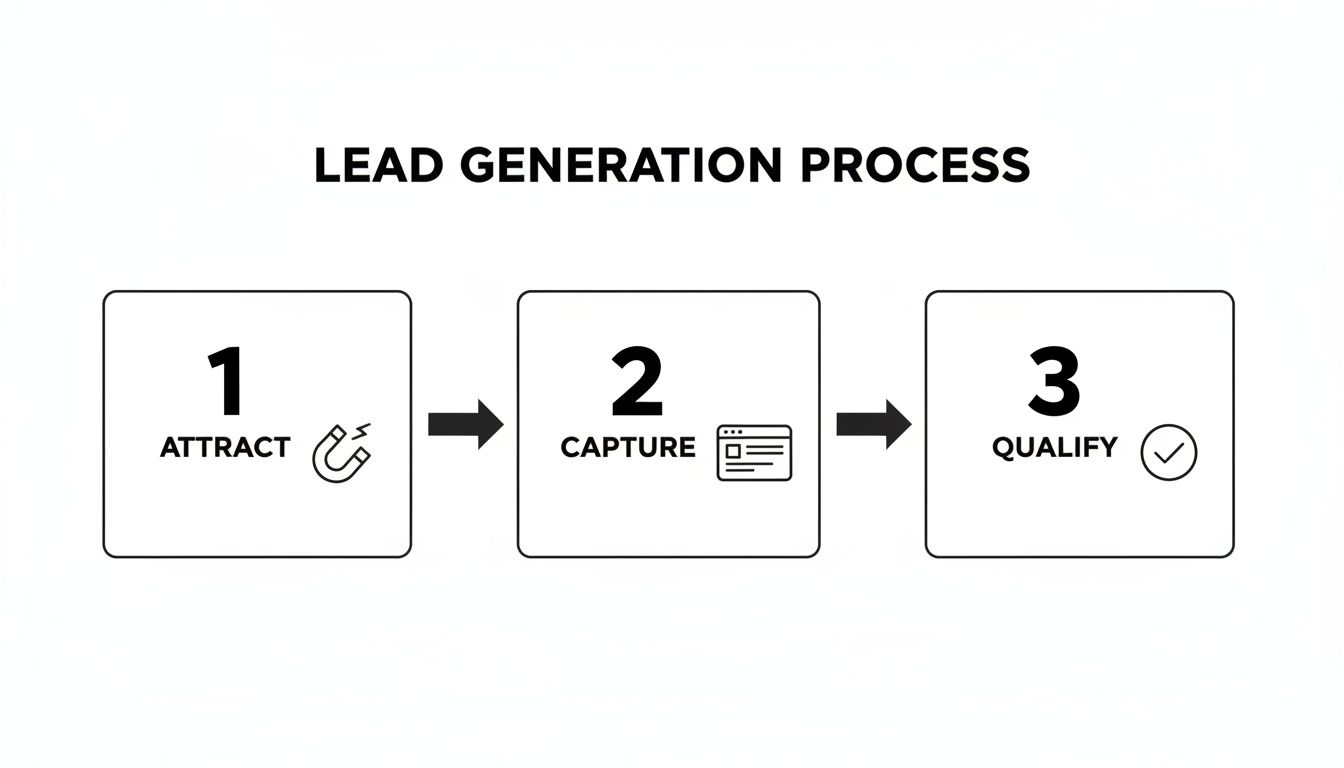
It’s a simple progression. Each stage enables the one that follows.
What are the qualification and routing layers?
Not every lead is ready for a sales call. The qualification layer is the smart wiring in your system, automatically sorting and prioritizing leads based on their likelihood to become customers. This is where automation begins to deliver significant returns, using data to make intelligent decisions at scale.
This usually involves a couple of key processes:
- Lead Scoring: Assigning points to leads based on their demographic data and on-site behavior. This helps surface the most engaged prospects.
- Data Enrichment: Automatically augmenting a lead's profile with information like company size or job title to create a fuller picture.
Once a lead is qualified, the routing layer sends it to the right place instantly. That could mean adding them to a specific email nurture sequence. For a high-intent lead, it might mean creating a new deal in the CRM and sending a Slack alert to the sales team. Speed is critical — responding within five minutes can dramatically increase conversions. For a deeper look, check out our guide on integrating marketing automation tools.
Connecting these layers is where the architecture comes to life.
CodeWords Workflow: Instant Lead RoutingPrompt: When a new lead fills out the HubSpot form, enrich their data with Clearbit, add them as a new contact in Salesforce, and send a summary to the #new-leads Slack channel.Output: A fully configured workflow is created, connecting HubSpot, Clearbit, Salesforce, and Slack.Impact: Reduces lead processing time from 15 minutes to under 5 seconds, ensuring immediate sales follow-up.
Which channels drive the highest quality leads?
Once you have a blueprint for your lead generation system, the next question is where to direct it. Many teams fall into the trap of thinking more channels automatically mean more leads. This is a myth that leads to scattered efforts, wasted budgets, and significant noise.
The real craft is not about being everywhere. It is about being in the right places — the select few channels that consistently deliver high-quality prospects.
But that’s not the full story. True efficiency comes from a deep understanding of each channel’s DNA: its audience, its costs, and the typical intent of its users. A channel that floods your pipeline with low-quality contacts is not an asset; it is a liability. It clogs your system and wastes your sales team's time. The goal is to build a focused, high-signal engine.
How do organic channels build value?
Organic channels are the bedrock of any sustainable lead generation strategy. They are assets you build over time that continue to produce value long after the initial work is complete.
The heavyweight here is content marketing. It is the powerhouse channel generating over 51.5% of all leads, far outpacing paid social (14.9%) and paid search (11.9%). This is not an accident. Valuable, educational content attracts prospects who are actively looking for answers, and it costs 61% less than outbound outreach. For a deeper look into these numbers, review Databox's 2025 lead generation report.
Here are the key players in the organic world:
- Content Marketing & SEO: Creating useful articles, guides, and tools that solve your audience's problems. SEO ensures people can find your content when they are searching.
- Email Marketing: Your email list is one of your most valuable assets. Nurturing your audience with targeted campaigns is an effective way to move leads toward a sale.
- Referrals: Never underestimate the power of a warm introduction. Encouraging happy customers to send new prospects your way often brings in leads with the highest conversion rates.
How do paid channels accelerate growth?
While organic channels build long-term value, sometimes you need to accelerate. Paid channels are your accelerators, giving you immediate, targeted reach to generate leads on demand. The secret is to use them with surgical precision, not with a shotgun. Focus on the platforms where your ideal customers already spend their time.
Paid channels demand careful budget management and smart audience segmentation. For B2B, LinkedIn is a dominant force, with some studies showing it is 277% more effective for lead generation than other major social platforms.
Your primary paid channels include:
- Paid Search (PPC): Capturing high-intent leads at the exact moment they are searching on Google for a solution like yours.
- Paid Social: Using platforms like LinkedIn and Meta to get sponsored content in front of specific audiences.
- Display Advertising: Placing visual ads on relevant websites to build brand awareness and drive top-of-funnel traffic.
The most durable strategies blend the long-term asset building of organic channels with the targeted acceleration of paid media.
How do different channels compare?
To make the right decision, you must compare channels on more than just the volume of leads they produce. You need to look at quality, cost, and strategic fit. A channel that is a goldmine for a B2C e-commerce brand might be ineffective for a B2B SaaS company.
Here's the bottom line: your channel mix must align with your business model and sales cycle. High-ticket B2B sales thrive on the trust built through content marketing and LinkedIn. In contrast, transactional B2C models might see faster results from paid social and search ads. The following table breaks down the top B2B channels to help guide your decision.
As the data shows, channels like Content Marketing/SEO and Referrals produce the highest quality leads, though they take time to build momentum. The strongest approach is a balanced one.
How does AI automation connect disparate platforms?
A modern growth stack is rarely a single tool. It is often a collection of specialized apps — one for your CRM, another for email, and a third for social media. The common wisdom suggests that adding more tools creates a tangled mess of disconnected data.
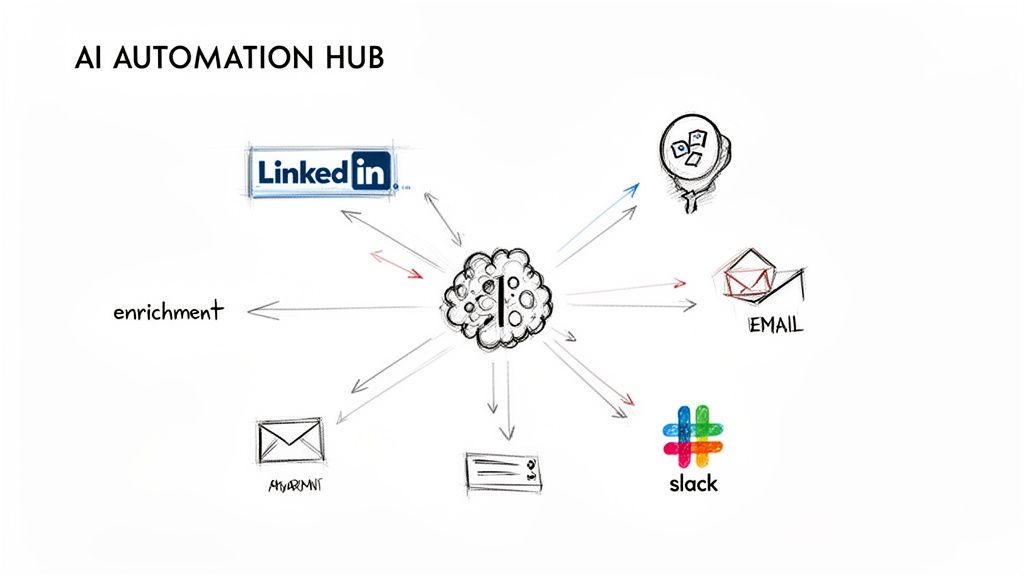
However, there is another way to think about it. An AI-native automation layer can act as the central nervous system for your entire lead generation architecture.
Instead of needing dozens of fragile, custom integrations, this layer connects everything. This is not just about syncing contacts; it is about building intelligent workflows that trigger actions across your entire tool stack, automatically. The result is a system where the whole is far greater than the sum of its parts, turning a fragmented set of tools into a single, cohesive engine.
How can you unify data with a central hub?
The single biggest challenge with using multiple lead gen platforms is data fragmentation. A lead’s information might be split between your marketing automation tool, your CRM, and a spreadsheet. An AI automation hub fixes this by acting as a universal translator.
Rather than building brittle, point-to-point connections between every app, you connect each one to the central AI layer. From there, the hub orchestrates complex, multi-step workflows. For instance, a new lead from a LinkedIn Ad can be instantly enriched, scored, and routed to the right salesperson’s queue in Salesforce — all in seconds.
This centralized model simplifies your tech stack. It reduces your reliance on hard-coded integrations and makes it easier to swap tools as you grow.
How do you automate cross-platform workflows?
Real automation is more than moving data. It is about creating smart, event-driven workflows that execute tasks across multiple applications. An AI-native platform excels at this because it understands context and can make decisions based on plain English instructions.
You might think building these workflows requires deep technical skill. Here’s why that's not always the case: modern AI automation platforms can interpret natural language commands, transforming them into functional code. One report found that leads from intent data platforms close 40% faster on average, largely because qualification is automated (Factors.AI, 2025). We walk through this exact concept in our practical guide to automating lead generation.
Here is what a typical AI-powered workflow looks like in practice:
- Trigger: A new lead fills out a form on your website.
- Action 1: The AI grabs the lead’s email and uses an enrichment tool to find company size and job title.
- Action 2: It then compares this data against your Ideal Customer Profile.
- Action 3: If it is a match, the AI creates a new contact and deal in your CRM.
- Action 4: Finally, it posts a notification in a dedicated Slack channel for the sales team.
This whole sequence happens instantly. A company in Singapore cut its lead processing time by over 70% in just three months by using an AI automation layer to connect its marketing and sales platforms. To see who else is innovating, you can learn more about different AI SaaS companies. By connecting your disparate lead generation platforms with an AI core, you turn siloed tools into an intelligent, self-running system.
What are the most essential platform features?
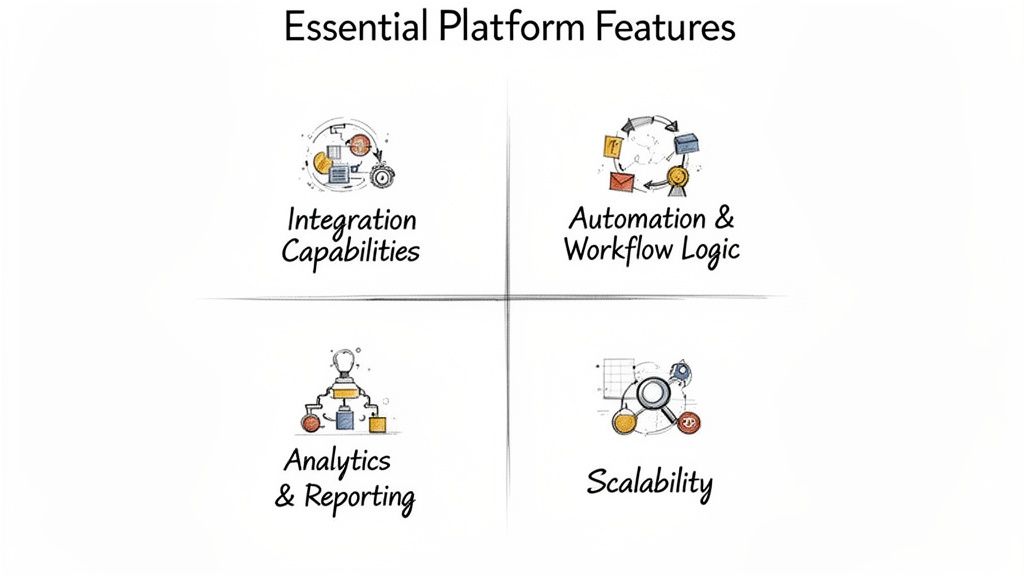
Picking a lead generation platform is an architectural decision. You are not just buying a tool with the longest feature list; you are choosing the structure that will support your company's growth. It is easy to get distracted by impressive numbers, like a platform boasting thousands of integrations.
But the real power is not in the quantity of connections. It is in their depth and flexibility. You need features that let you build smart, automated workflows that can keep up as your business grows.
Why do integration capabilities matter?
A platform that cannot communicate with your existing tech stack is a non-starter. But be careful — shallow integrations that only sync basic contact info often create more problems than they solve. The critical capability here is deep, trigger-based integration.
The goal is a seamless flow of data where every tool can not only share information but also trigger actions in other systems. This is what turns a random collection of apps into a truly unified operation. For anyone serious about building a connected system, understanding how an API integration platform works is essential. It is the backbone of any modern setup.
What should you look for in automation?
A good lead generation platform should eliminate manual work. This means much more than simple email autoresponders. You need a system with robust workflow logic that can handle conditional routing, smart lead scoring, and complex sequences across multiple applications.
Real automation is about building intelligent, event-driven processes. Look for features like:
- Conditional Logic: The ability to build "if this, then that" rules. For example, if a lead’s company has over 500 employees, route them to the enterprise sales team.
- Lead Scoring: Automatically assigning points to leads based on their profile and actions. This helps you instantly identify the highest-intent prospects.
- Multi-Channel Triggers: Initiating a workflow from anywhere — a form submission, an email open, or a social media interaction.
This kind of automation ensures every lead gets the right follow-up at the right time.
What kind of analytics are necessary?
You cannot improve what you do not measure. A top-tier platform delivers clear, actionable insights into every stage of your lead funnel. Forget vanity metrics like the total number of form fills. You need reporting that ties your marketing spend directly to revenue.
A 2025 study from Factors.AI found that leads sourced from intent data close 40% faster than traditional leads. This is the type of insight you can only uncover with sophisticated tracking. Your reporting features should answer the big questions, showing you exactly which touchpoints pushed a lead across the finish line.
Why are scalability and flexibility important?
Finally, the platform must grow with you. A system that works for a startup handling 100 leads a month will fail under the weight of 10,000. Scalability is not just about handling more volume — it is about maintaining performance, flexibility, and cost-effectiveness as you get bigger.
This means the platform should let you customize workflows on the fly without needing a developer. As your strategies evolve, your system needs to adapt without requiring a complete rebuild. True scalability is about architectural resilience.
What are the implications for your growth strategy?
Viewing lead generation platforms as mere contact collection tools misses the point entirely. This is about a fundamental shift in thinking: from manually reacting to leads as they appear, to architecting a predictable, scalable growth engine. It is about building a business that generates revenue consistently.
When you automate the top of your funnel, you are not just saving a few hours. You are building a system that works for you, around the clock. This frees up your team to focus on what humans do best: closing deals, building relationships, and solving complex customer problems. Less time chasing down information, more time making an impact.
The end goal is to transform lead generation from a chaotic, tactical function into a core strategic asset. A well-designed system is a compounding advantage. Every article published and every workflow automated adds another layer of strength to your revenue engine. Your growth becomes less about brute force and more about smart design.
This is especially true when you direct your automated engine at proven channels. In the B2B world, LinkedIn is responsible for a staggering 80% of all B2B leads. A full 89% of B2B marketers rely on it because it works. You can see more stats like these on Salesgenie.com. By aiming automated systems at high-yield channels, the entire operation becomes incredibly efficient.
An automated, integrated system for bringing in leads is the new operational baseline for any company serious about growth. The real implication is moving beyond the daily scramble for the next customer. Instead, you are building the machine that finds them for you, reliably and forever.
Frequently asked questions
What's the real difference between a CRM and a lead generation platform?
A CRM is built to manage relationships with people already in your world — nurturing existing contacts and customers. Lead generation platforms, however, are designed to attract, capture, and qualify entirely new prospects before they enter your CRM. They work at the top of the funnel, while CRMs own the middle and bottom.
How many lead generation tools are too many for a startup?
The real issue is usually a lack of connection between tools, not the number of tools. A startup can run a lean growth machine with just three or four core platforms — one for content, another for forms, and one for email. The secret is tying them together with a central automation layer.
Can I build my own lead generation platform with no-code tools?
Yes, you can stitch together a custom stack using no-code tools to act as your lead generation platforms. The main challenge is not building the individual pieces; it is making sure they communicate reliably. This is where an AI-native automation platform becomes essential, unifying a custom system without creating technical debt.